
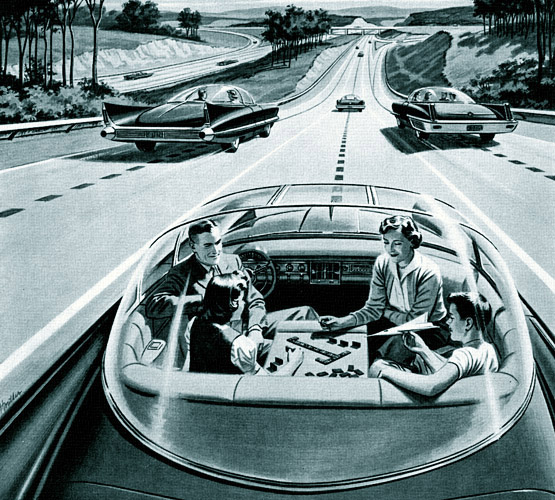
A 1956 Vision of the Self Driving Car
By Omar Billawala
In the future, we hear, cars will be able to drive themselves! We will be able to summon a car that we effectively share, to come pick us up in the morning and drive us to work while we eat breakfast, get a little extra sleep or start our workday. When we arrive, there will be no need to park it as it will just drive off. The advantages are staggering. We will be able to live further from where we work, in less expensive neighborhoods, with less commute inconvenience. Traffic accidents and insurance costs will plummet as smart cars will avoid collisions with silicon’s-far-quicker-than-hand-eye coordination/decision-making capabilities. We won’t even need put out the large sums of money required to own and maintain our own cars as we can more efficiently share cars or hire cars on an as-needed basis. Parking, taxis, and trip transportation scheduling will no longer be a significant concern. We will finally realize the promise of the first cars–to be, in a limited geographic sense, free!
Self driving cars are the future! So, when will this future arrive on our doorstep?
This is where the opinions begin dramatically diverging. Google, which is presently demonstrating self-driving car technology, albeit with a person at the wheel and an engineer along for the ride, predicts this will happen by 2020. Also in the 2020 camp are Audi, BMW, GM, Mercedes and Nissan. Daimler and Ford are a little more conservative, predicting 2025. Even the IHS Automotive, a market intelligence company, agrees with the 2025 date and goes further to predict that the majority of vehicles on the road will be self-driving by 2035. If industry consensus is to be believed, self driving cars should be wreaking havoc with our established way of doing things in just over 10 years!
For those of you who insist on holding onto that steering wheel tightly, there is some hope that that the future can be put on hold for a few more years. Even if the fundamental technology solutions relating to making a car smart enough to intelligently maneuver on our roads in a safe manner were completely solved, there are a number of potential speed bumps on our road to automaniation.
One of the classic objections asks, in a situation where a self-driving car will get into a situation where it will have to hit one of two pedestrians (say an old person and a child), how the choice will be made as to who will be injured, maimed or killed. While this seems like a difficult, perhaps intractable, ethical and philosophical dilemma, the solution to which path should be taken is likely easily solved by choosing the perceived less of two evils. Cars will be constantly evaluating the relative safety of alternative courses of action and based on programming and algorithms, the chances that two different courses will have the same damage score is about the same chance as picking two identical random 20-digit numbers (i.e., effectively, zero.)
Some of the lesser-talked-about but more challenging problems that self-driving cars present relate to privacy, safety, and economic upheaval. I am not referring to the privacy compromise related to there being a complete record of everywhere you have been driven, or even to the possibility that your routes could be skewed based on commericial considerations–as one commentator put it, your route could be modified to always taking you by a Krispy Kreme Donut location in the hopes of inducing you to impulse purchase some of their diabetes dunkers)–but rather the nearly total potential visual and audio record of everything you do when you are out in public within sight of self-driving cars. Self driving cars will be deeply aware of their surroundings in a digital sort of way and, as with anything digital, it can be easily stored. We are at the early stages of a loss-of-privacy revolution and we will still getting accustomed to loss of location privacy and that we can be photographed in public. How are we going to feel when our whereabouts are not just tracked but videoed. Jaywalkers, vandals, drug dealers, nose-pickers prepare to be publicly outed or arrested.
No one realistically questions that self-driving cars, as a whole, under normal operating conditions are going to drive more safely than their human counterparts. The more pernicious safety issues arise as a result of how self-driving cars can be used by those with nefarious motives. Cars are heavy–even the smaller Smart Cars weigh in at about 2,000 pounds. Combine significant weight with velocity and, from a physics perspective, you have a weapon. Add intelligence and it starts to look like a smart bomb. Add a further layer of anonymity and it starts to look like the protagonist is a perfect murder movie. Imagine you could send a self-driving car on an errand to run over your worst enemy, or just someone whose annoyed you, without any criminal or civil consequences. You might not take advantage of this new found freedom but the sociopaths next door might. It might seem like the final ingredient, anonymity, is, per se, impossible. After all, self-driving cars are going to know everything about who they are serving. When we call for a smart car to go somewhere we will invariably be providing some sort of identification. In Utopia this would always happen. Unfortunately, we live on Earth and things don’t always happen as they should. Try as we might, we seem unable to prevent virus writers and all sorts of other malware from invading our systems. Do you feel confident that we will have perfectly hackproof self-driving cars in the next decade or so? I do not!
Finally, there has been talk about some of the economic ramifications that will result from self-driving cars. We are already seeing companies such as Uber, Lyft and Zipcar as the beginning of the end of the taxi-driver profession. Self-driving cars (and trucks) will spell the end of so much more. Truck drivers, transit drivers, delivery drivers might fall by the wayside. The approximately 50% of insurance dollars that are spent insuring cars will be reduced to a small fraction, and the insurance labor force will necessarily have to shrink. Not owning 100% of your car will become common. Many people own multiple vehicles because sometimes they need a truck to carry heavy loads or a minivan to take a larger group somewhere. The inexpensive rental/sharing of such vehicles which can show up at your door when you need them will contribute to the devastation in automobile industry jobs as people purchase fewer extra “convenience” vehicles. The real estate market, particularly in urban areas, will similarly experience upheaval. Location-based pricing pressures will be reduced hitting certain home values hard while more outlying real estate will be come more attractive and provide an accretive effect to home values. Self-driving cars will shake up our economy. Are they the only innovation that will do this in the near future? No! 3D printers, robots, biotech and nanotech advancements, online education, and many other marvels of modern technology will also contribute to the economic roller-coaster that we will be riding in the future. Since there is no getting off, you might as well just enjoy the ride!






 Tick-Tech-Toe