
By Omar Billawala
2015’s Consumer Electronics Show, held in Las Vegas from January 6th to 9th was the largest ever, drawing more than 170,000 attendees and 3,600 exhibitors. This year’s show was filled with more innovative products than ever before. Many of the smaller companies were born on Kickstarter or Indiegogo or plan to market their products there in the near future.
Intellectually, I understand that I should be scared of the many of the directions that technology is taking us. I should be scared of how our personal privacy is being eviscerated, how disruptive products and services are destroying industries that provide many of our country’s jobs. I should be deeply concerned about the our moving from the Internet of Information to the Internet of Things is going to make even our homes and automobiles subject to being hacked, how smart devices are dumbing down our children. Indeed I am worried about these things, but the scariest thing I saw at CES came from a four-year-old company called Tracking Point.
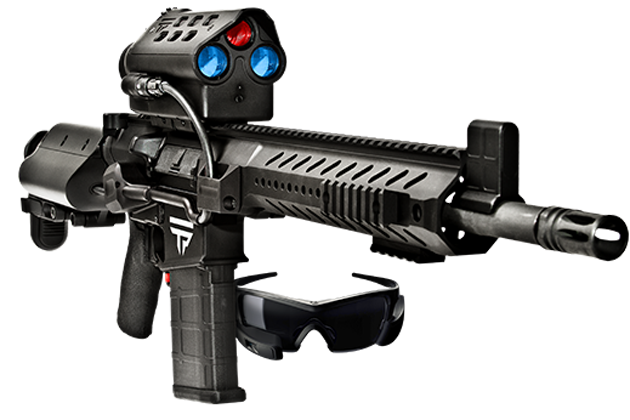
Tracking Point’s story began with John McHale. John was a hunter and while on safari in Africa in 2009, he could not hit a target 400 yards away. He felt that, with current technology, there must be a way for a rifle to rapidly account for the range, ballistics, stability, and other factors, involved in precision targeting over large distances. So he, along with an engineer, John Lupher, started a company and hired top talentin imaging, tracking, mechanical engineering, electrical engineering, industrial design, software, and the firearms industry. Then end-result of the team’s efforts is a series of rifles with astonishing capabilities.
Tracking Point’s rifles are both super cool and very frightening. Tracking point advertises that, “Shooters of any skill level can now shoot better than the best shooters who ever lived.”

To operate the rifle, you enter the estimated wind speed in increments of 0.5 mph and note whether it is coming from the right of left of the barrel. Then you aim at the target you wish to hit and, when it is in your cross hairs, you push a red “tag” button. Now the rifle’s software takes over and begins tracking the object. When you are close you pull the trigger. The gun will not fire immediately. The display will show a red dot on the tagged target and will shift the display to show you where to aim. You simply put the red dot in the center of the cross hairs and the rifle will fire. It takes into account the range, wind, ballistic curves, temperature, humidity, incline, cant, coriolis effect, barrel wear, zeroing shift, and other variables related to shot accuracy.
Tracking Point’s introductory rifle sells for $7,500 and can hit a target 500 yards away and moving at 10 mph. Its high-end rifle sells for $27,500 and can hit a target 1,300 yards away and moving at 25 mph. At CES Tracking Point introduced a $40,000 rifle capable of hitting a target 1,800 yards away. For sport hunting (perhaps this takes the “sport” out of it) and for military purposes these rifles seem to be fantastic tools. One caveat is that you don’t want to be seeing the laser tag from the wrong side of the barrel.


 Tick-Tech-Toe